
 Micro Dynamic Sensor
  Sample Preparation
  Test Accessories
  Digital Image Measurement
  Geotechnical Tests
  Rock Tests
  Coarse-grained Soil Tests
  Other Tests
  In-situ Tests
  Engineering Investigation
  Drilling Rigs
  Ocean Testing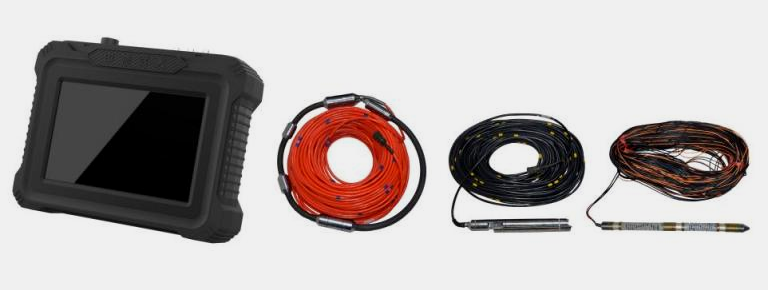
Application Scope
The ZD-A10 Downhole Excitation (P·S) Wave Velocity Tester is suitable for the following scenarios:
P-S wave testing of rock and soil layers in engineering investigation; Classification of site soil types and site categories;
Fields related to studying formation wave velocity, such as engineering geological investigation, railway survey, seismic evaluation, geological hazard monitoring, and water conservancy and hydropower investigation and design.
Functional Features
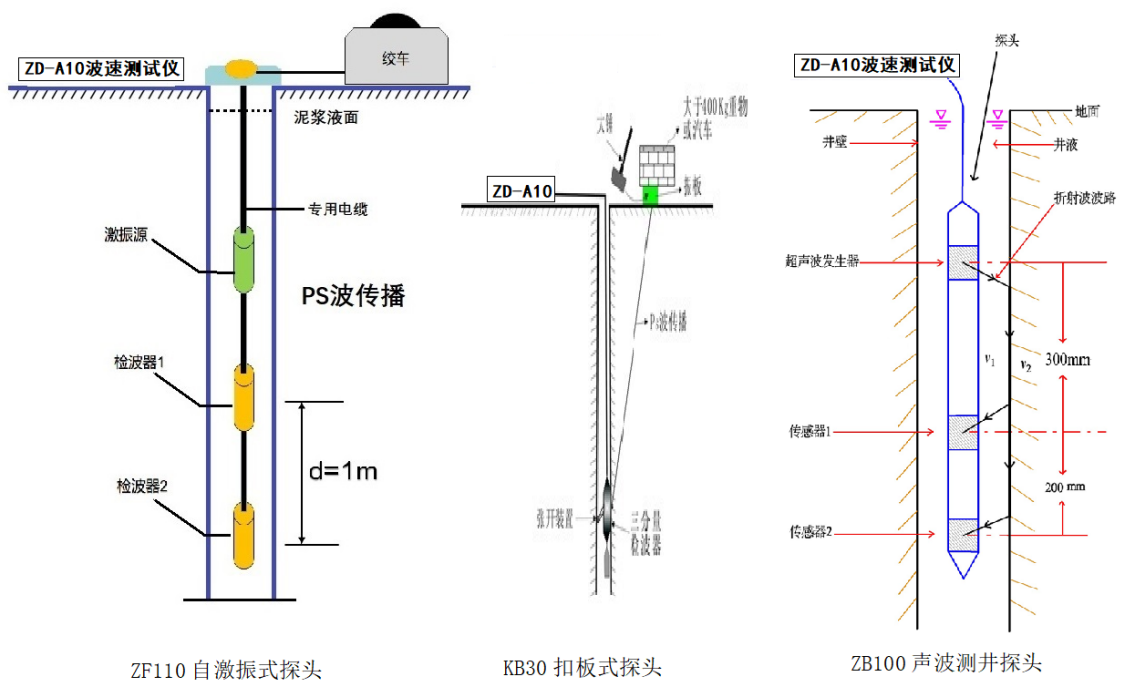
Downhole Vibratory Excitation Method: The downhole vibratory excitation method (self-excitation and self-reception) refers to excitation and reception both conducted in the borehole. It does not require a ground vibration source and enables accurate testing of shear wave velocity.
Plate Tapping Method: This method uses a heavy hammer to strike a ground vibration plate or steel plate for testing the shear wave velocity and compressive wave velocity of the stratum.
Single-Excitation Dual-Reception Test for Rock in Borehole: This test is used to measure the longitudinal wave velocity of rock in the borehole.
Low-Frequency Ground Microtremor Dominant Period Test: This test is conducted to measure the dominant period of low-frequency ground microtremors.
Logging Probes
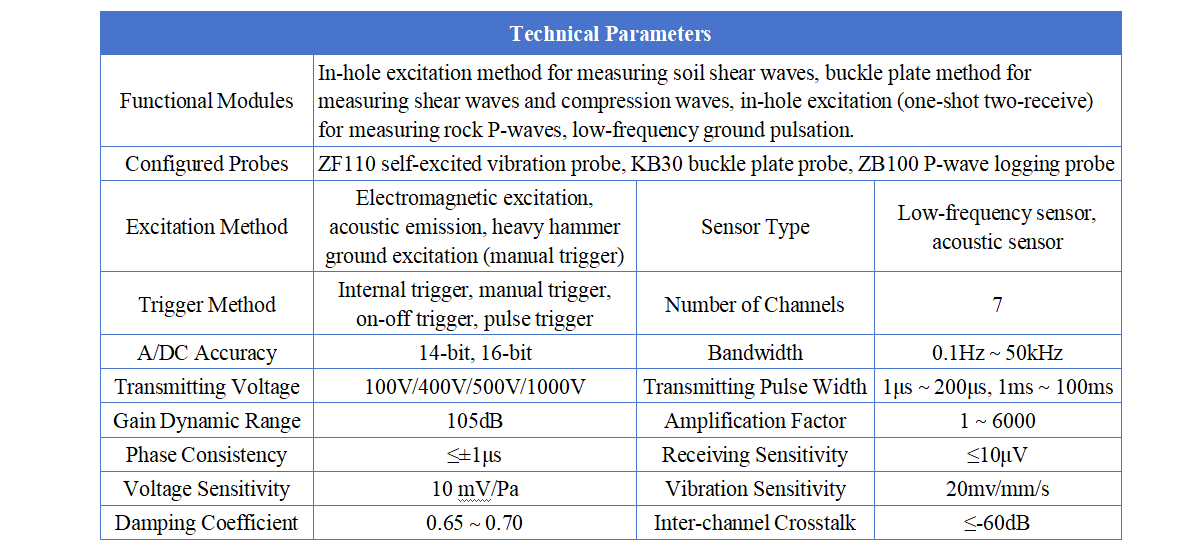
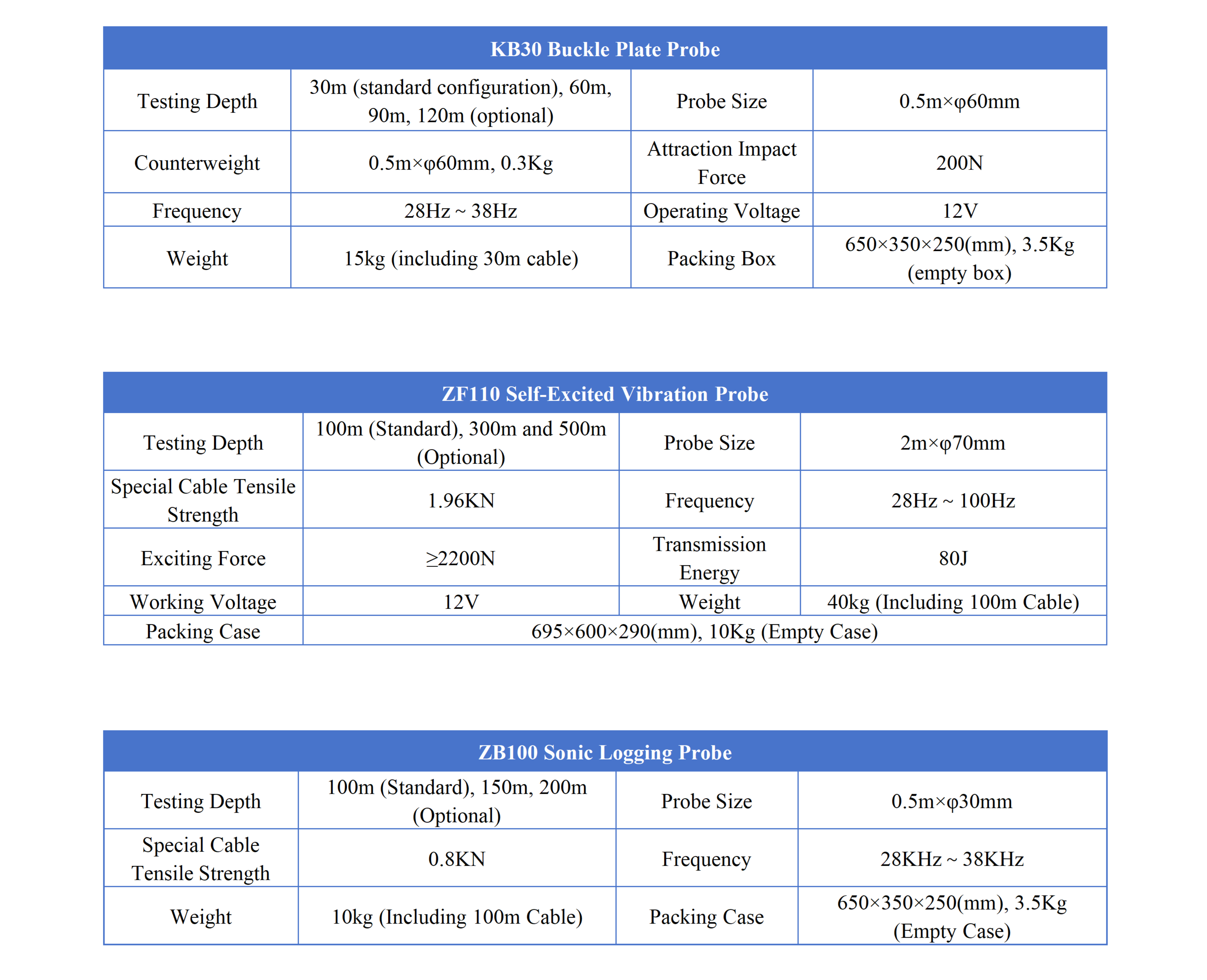
ZF110 Self-Excited Vibration Probe: It adopts a structure where the upper part serves as the excitation source and the lower part is equipped with two receiving geophones. The electromagnetic vibration excitation source exerts an instantaneous impact force perpendicular to the wellbore wall. It collects shear waves (S-waves, transverse waves) whose particle vibration direction is perpendicular to the wellbore wall and which propagate along the direction of the wellbore wall.
KB30 Buckle-Type Probe: It uses a three-component geophone and an electromagnetic automatic suction method to open the bracket. The bracket can be controlled to open by pressing a key on the host at any depth in the borehole, and no mechanical operation is required for opening. This probe is not significantly affected by mud resistance, which prevents the situation where the bracket is opened before the probe is placed at the bottom of the borehole. Thus, it avoids the repeated operation of lifting and lowering the probe, which would otherwise waste time. Unlike the mechanical opening method (where the probe must be lowered to the bottom of the borehole and the bracket is opened by mechanical force), this probe eliminates such drawbacks.
ZB100 Acoustic Logging Probe: The acoustic testing is conducted using a downhole transducer with one transmitter and two receivers. The distance between the transmitter and the first receiver is 30 cm, and the distance between the first receiver and the second receiver is 20 cm. It collects the first-arrival wave waveform, automatically identifies the kick-off point to determine the first arrival time of the P-wave (longitudinal wave), and then calculates the P-wave velocity.

 Customer Service QQ